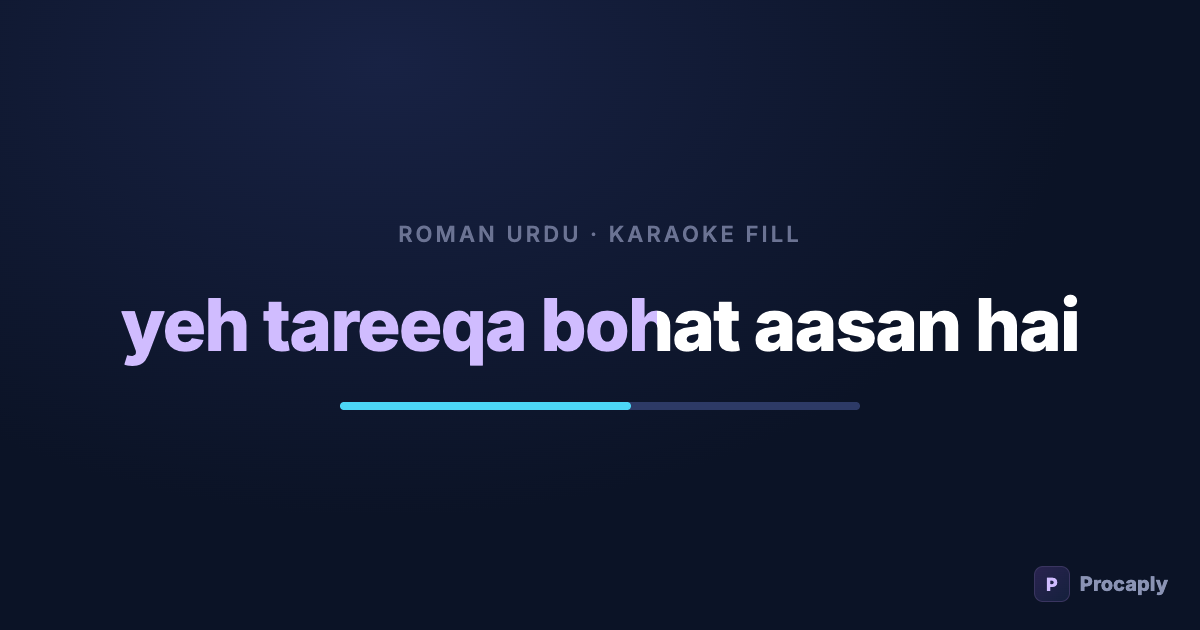
Open the comments on any Pakistani or Indian creator's Reel and you'll see the real national writing system of desi internet: Roman Urdu — Urdu and Hindi written in the Latin alphabet. "yeh tareeqa bohat aasan hai." No font problems, no script literacy required, typed on the same keyboard as English.
- Roman Urdu reaches everyone who speaks Urdu/Hindi — a far bigger audience than script readers.
- Spelling consistency is the difference between professional and sloppy; fix one spelling per word.
- Generic caption tools don't offer Roman Urdu at all — it needs transliteration, not translation.
- Script still wins for poetry, deen and literary content — or run both in a bilingual layout.
Captioning your videos the same way your audience writes is one of the easiest retention wins available, and it's badly under-used.
Why Roman Urdu outperforms script for most creators
- Everyone who speaks it can read it. Urdu script literacy is far smaller than Urdu speech — especially among Gen-Z, Indian Hindi-speakers watching Urdu content, and the diaspora. Roman Urdu captures all of them.
- It reads faster. Short-form captions are on screen for a second or two. Latin script at bold weights is instantly scannable; Nastaʿlīq at small sizes is not.
- Code-switching looks natural. Real desi speech is 20–40% English. In Roman Urdu, "simply AI tools use karo" is one seamless line rather than two scripts colliding.
- Every viral caption style works. The bold pop fonts, karaoke fills and word highlights you see on big creators' videos are all built for Latin text.
The catch: spelling consistency
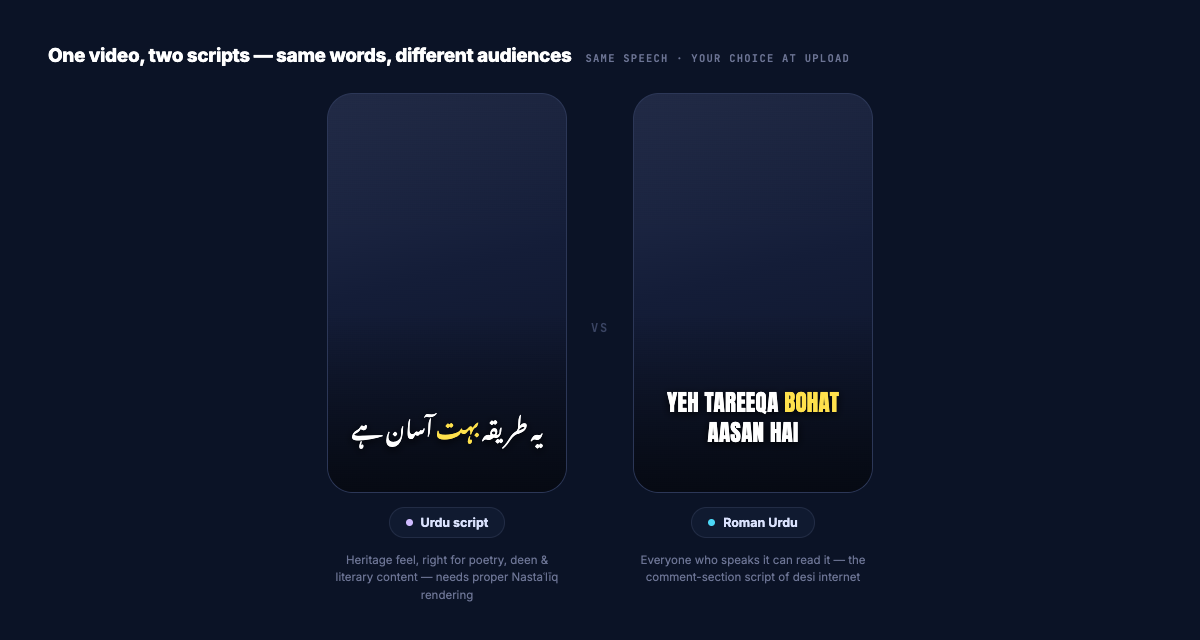
Roman Urdu has no official spelling, and inconsistency is what makes captions look amateur. "Bohat" in caption 3 and "bohot" in caption 33 reads sloppy in a way viewers feel even if they can't name it. The fix is to pick one spelling per word and never vary it. The de-facto standard the big pages use:
| Use | Not |
|---|---|
| nahi | nahin, nai, nhi |
| bohat | bohot, buhat, bahut* |
| acha | accha, achha |
| kyunke | kyunki, qk |
| main (I) / mein (in) | mei, me for both |
*bahut is the Hindi-flavoured spelling — fine, but pick one flavour and stay in it. If your audience is Indian, see our Hinglish guide.
Auto-generating Roman Urdu captions
Generic caption tools can't do this — Roman Urdu isn't a "language" in their menus, and machine translation is the wrong operation anyway: you want the same words your audience heard, in a different alphabet. Procaply treats Roman Urdu as a first-class output: it transcribes your Urdu/Hindi speech, then transliterates with a fixed canonical spelling list, so every caption uses the same spellings the table above shows. English words are kept in correct English spelling — "business", not "bizness".
Styling Roman Urdu like the top pages
- Heavy geometric fonts — Anton, Montserrat ExtraBold, Poppins Bold. Roman Urdu's short words look great set large.
- UPPERCASE for pop styles. "BOHAT AASAN HAI" carries energy lowercase can't — and Roman Urdu has no reading cost in caps.
- One highlighted keyword per line in your accent colour — the AI pre-picks the strongest word; adjust it if the joke lands elsewhere.
- 3–5 words on screen at a time, synced to speech, beats parked full sentences every time.
When script still wins
Poetry, na'at and ghazal content, religious material, and anything targeting audiences who read Urdu daily — the script carries weight and identity Roman letters can't. Many creators run script captions as the primary line with a smaller Roman or English second line. (Procaply supports exactly that two-line bilingual layout.)
Frequently asked questions
Does Roman Urdu hurt discoverability?
The opposite, usually — platform search and SEO index Latin text well, and "bohat aasan tareeqa" is searchable in a way burned Nastaʿlīq pixels never are. Use your caption text in the post description too.
Roman Urdu vs Hinglish — same thing?
Nearly. Same idea, different flavour: Hinglish leans on Hindi vocabulary and spellings (bahut, accha), Roman Urdu on Urdu ones (bohat, acha). Pick the one matching your audience; Procaply offers both as separate output languages.
Will Indian Hindi-speaking viewers understand Roman Urdu captions?
Almost entirely, yes — spoken Urdu and Hindi overlap heavily, and in Latin script the differences mostly disappear. This is exactly why Roman captions out-reach either native script.
Can I switch a video I already captioned in Urdu script to Roman Urdu?
Yes — language switching re-writes the caption text while keeping every timestamp, so your styling and timing survive the switch.